


Knowledge
Magnesium Alloy Forming Technologies Contribute to Shaping a Lightweight Future (extrusion, rolling, forging)
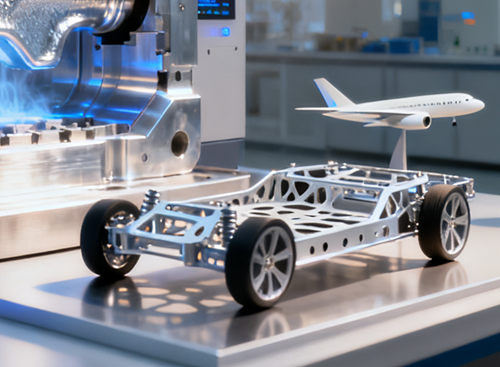
Forming technology of wrought magnesium alloys: The key to enhancing performance
Forming technology of wrought magnesium alloys alters the microstructure of magnesium alloys through plastic processing methods such as extrusion, rolling, and forging, significantly improving their mechanical properties such as strength and ductility. This technology is suitable for manufacturing structural components with high reliability requirements, such as automotive chassis and aircraft engine blades. However, due to the hexagonal close-packed crystal structure of magnesium alloys, they have only one slip system at room temperature, resulting in extremely poor plasticity. Therefore, magnesium alloys are usually heated to 200 - 450℃ for hot working to improve their formability. The forming technology of wrought magnesium alloys mainly includes the following types:
Extrusion forming: Manufacturing process of profiles and tubes
Extrusion forming involves placing a heated magnesium alloy billet (at a temperature between 200 - 450℃) into an extrusion cylinder and applying pressure through an extrusion ram (pressure range of 100 - 500MPa) to extrude the billet through a die hole, thereby forming tubes, bars, and complex profiles. The extrusion process refines the grain size, reducing it from 50μm to 5 - 10μm, which increases the tensile strength by 30% - 50%. Additionally, this technology can produce profiles with complex cross-sections, such as automotive crash beams and high-speed rail seat slide rails.
1. The key parameters of extrusion forming include the extrusion ratio (the ratio of the cross-sectional area of the billet to that of the product, generally between 5 and 50) and the extrusion speed (usually 0.5 - 30 m/min). The dimensional accuracy of the product can reach IT9 - IT11, and the material utilization rate is approximately 85%.
2. Rolling forming: An important method for sheet production
Rolling forming is a process that uses hot rolling (at temperatures between 250 - 400℃) or warm rolling (at temperatures between 150 - 250℃) to roll magnesium alloy billets into sheets with thicknesses ranging from 0.1 to 10mm. Due to the tendency of magnesium alloys to crack at room temperature, the reduction rate during rolling must be strictly controlled, typically less than 15%, and most often unidirectional rolling is used to prevent transverse cracking. The sheets obtained through rolling have good surface quality, with surface roughness Ra values ranging from 1.6 to 6.3μm, and excellent ductility, with elongation rates of 15% - 20%. They are highly suitable for manufacturing automotive body panels, aircraft skins, and other products.
However, rolling forming also faces some technical challenges. For instance, the temperature window for rolling is relatively narrow, typically only 50 - 100℃, and precise control of the roller temperature and rolling speed is necessary to avoid defects such as edge cracking and waviness. Additionally, there are certain limitations on the width of rolled sheets in China at present, with the maximum width being 2000mm.
3. Forging forming: A choice for manufacturing high-strength parts
Forging forming involves placing heated magnesium alloy billets (at temperatures between 200 - 400℃) into a forging die and applying impact or static pressure through a press to cause plastic deformation of the billet, thereby obtaining parts of the desired shape. Forging can completely eliminate internal defects in castings, such as porosity and looseness, and increase the tensile strength of magnesium alloys to over 400MPa, which is more than 50% higher than that of castings. Therefore, forging forming is suitable for manufacturing core components that bear heavy loads, such as automotive crankshafts and aircraft engine turbine discs.
Isothermal forging is a mainstream technology in forging. During isothermal forging, the die and the billet are kept at the same temperature (generally between 250 and 350℃), which can prevent the plasticity of magnesium alloys from decreasing due to rapid cooling and enable the forming of complex curved surface parts. However, the production cycle of isothermal forging is relatively long, with single-piece production usually taking 1 to 2 hours, and the cost is relatively high, about 3 to 5 times that of die casting.
Magnesium alloy forming technology helps shape a lightweight future (semi-solid injection molding)
Semi-solid injection molding technology: A new dawn for magnesium alloy forming
1. Forming principle
At room temperature, granular magnesium alloy raw materials are forcibly conveyed from the hopper to the cylinder. As the screw in the cylinder rotates, the alloy particles are gradually pushed towards the mold. When the particles pass through the heating zone of the cylinder, they transform into a semi-solid state. Under the shearing action of the screw helix, the originally semi-solid dendritic alloy structure is further converted into a granular primary phase structure. When the cumulative volume of the semi-solid alloy reaches the preset requirement, it is injected into the preheated mold at a high speed of 5m/s, and the forming process is completed. Currently, this technology is widely used in the manufacturing of appearance parts for laptops, game console shells, mice, photographic equipment, medical shells, etc.
2. Process Flow
The semi-solid injection (molding) forming technology is derived from the plastic injection molding process and is mainly applied in the forming process of metal materials. Its core process flow is as follows: spraying mold release agent → closing the mold → injection → forming → removing the formed part.
3. Process Advantages
After manufacturing notebook computer shells and other components using semi-solid injection molding technology, they have significant advantages such as uniform microstructure and no shrinkage cavities or porosity. Their comprehensive mechanical properties are similar to those of forged parts and are superior to traditional die-cast parts. Through this technology, the mechanical properties of light alloy materials such as magnesium-aluminum alloys can be effectively enhanced.
Compared with traditional die-casting processes, the advantages of semi-solid injection molding technology are specifically reflected in the following aspects:
1. The finished product has a low porosity rate and significantly improved mechanical properties;
2. It has excellent dimensional accuracy and strong dimensional stability;
3. The wall thickness ratio (L/D) of the mold is higher, allowing for the formation of thin-walled parts;
4. It can achieve one-piece molding of complex and precise structural products;
5. The shrinkage during the molding process is small, and the operating temperature is low, which helps to extend the service life of the mold;
6. The amount of waste generated from gates, runners, and overflow channels during the molding process is small;
7. The process control difficulty is low, the product quality is stable, and the production yield is high;
8. The metal solidification time is shortened, reducing energy consumption and environmental load in the molding process;
9. No furnace is required, simplifying the production process and making it safer and more convenient for employees to operate.
The Future Outlook of Magnesium Alloy Forming Technology
With the continuous advancement of technology and the continuous growth of industry demand, magnesium alloy forming technology will also face new development opportunities and challenges. In the future, casting technology will upgrade towards high precision and low energy consumption. For example, vacuum die-casting technology will be combined with AI technology to monitor die-casting parameters in real time, reducing the scrap rate of castings from the current 5% - 8% to 1% - 2%. Sand casting may develop towards "3D printed sand cores", shortening the production cycle by 50% and being more suitable for the production of customized large parts. Deformation technology will focus on breaking through the limitations of wide width and thin walls. Rolling technology is expected to break through the width limit, aiming to reach over 3000mm to meet the demand for large cover parts in new energy vehicles. Extrusion technology may develop towards "continuous extrusion", enabling the production of infinitely long profiles and reducing the cost of magnesium alloy profiles used in high-speed rail and metro.
As the cost of equipment gradually decreases (currently, the price of a semi-solid equipment set has dropped to twice that of traditional die-casting (including the supporting furnace), and it is expected that the price will continue to decline with the increase in production volume, and is likely to be on par by 2030), we predict that semi-solid technology will gradually replace the mid-to-high-end die-casting and some forging markets. Some experts predict that by 2027, the proportion of semi-solid formed magnesium alloy parts will increase from the current 5% to 20%, achieving large-scale application in automotive structural parts, precision electronic components, and other fields. Conclusion
In conclusion, the wave of lightweighting is sweeping across, and magnesium alloys have become a significant force in this trend due to their outstanding performance. As the key to transforming the advantages of magnesium alloys into practical products, magnesium alloy forming technologies, ranging from traditional casting and deformation processes to the cutting-edge semi-solid injection molding technology, each innovation and breakthrough is driving the expansion and deepening of magnesium alloy applications.
Vigor team has more than 20 years experience in casting, forging, cold forming processes and the post treatment, as well as a robust surface treatment supply chain. If anything we can help or any parts you want to develop, please contact us at info@castings-forging.om