


Knowledge
Grain Refinement and Adjustment in the First Heat Treatment of Large Forgings
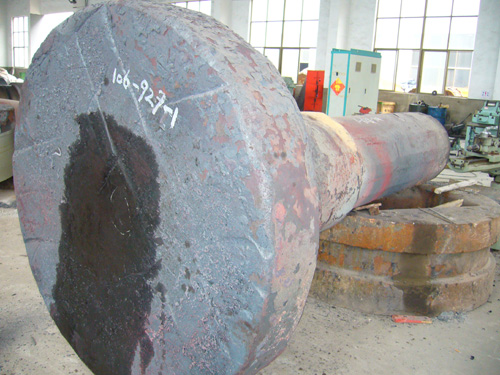
I. Coarse and Inhomogeneous Grains in Large Forgings
Rolled products and small forgings processed under pressure are prone to obtaining fine and uniform austenite grains. Parts made from such billets and subjected to quenching and tempering treatment (provided that the raw materials and heat treatment processes are normal) usually achieve fine grains of grade 8 or above, which are relatively uniform. However, large forgings are different. G. Bendel et al. 24 took radial and axial samples from oil-quenched and tempered generator shafts (28NiCrMo74), turbine rotors (21CrMoV51), and other large forgings of different steels. They studied the metallographic structures of nearly 200 samples from 100 forgings (with diameters ranging from 400 to 1400 mm, forged from 100 to 150-ton steel ingots) using picric acid and additives to reveal austenite grains. The results showed that the austenite grains of all 200 samples were within the range of 0 to 7 grades, with 3 to 4 grades (excluding those smaller than 3 grades) accounting for 50%. We have also encountered similar situations in the production of large forgings.
Why are the austenite grains in large forgings always relatively coarse and uneven?
Firstly, the ingots used for forging large forgings are large, and the cooling process during crystallization is slow, which results in coarse as-cast structures and relatively severe segregation. The austenite in the segregation zones containing carbon and alloy elements is particularly stable (especially in high-alloy steels). If no special treatment is taken, the coarse austenite in this area may still not be fully transformed even during the final treatment. The transformation characteristics brought about by segregation will be further discussed below.
Secondly, compared with rolled materials and small forgings, large forgings have smaller and unevenly distributed forging deformation. Therefore, the recrystallized grains are also relatively coarse and unevenly distributed. This point has been discussed in Chapter One and will not be repeated here.
Large forgings generally cannot be forged in one go. In the final forging process, due to the large temperature difference between the cross-sections of the forging and the slow action of the hydraulic press, the final forging temperature of the parts forged earlier and those forged later varies greatly. The center of the forging and the parts forged earlier remain at high temperatures (often above 1000℃) for a long time, which leads to coarse and uneven austenite grains.
Thirdly, the coarseness and inhomogeneity of austenite grains within large forgings are also related to the characteristics of their austenitizing heating and cooling processes.
Considering the segregation of carbon and alloying elements, the austenitizing temperature for large forgings is higher than that for small pieces of the same steel grade, as the upper limit of Ac in the forging is higher than this temperature of the average composition. Additionally, large forgings require a longer soaking time for uniform heating, which causes the surface layer to remain at high temperatures for an excessive period.
Even if the heating temperature and holding time are the same, the austenite grains in large forgings are coarser than those in well-processed rolled materials and small forgings. The most important reason for this is the heating rate in the α→γ transformation zone. The slower the heating rate, the coarser the austenite grains. Due to the absorption of transformation heat during the α→γ transformation in large forgings (which has no significant impact on small parts compared to the heat supply capacity of the heating furnace), the heating rate during the entire transformation process is reduced to a very low value, resulting in coarser grains. Adding a small amount of strong carbide or nitride-forming elements to refine the austenite grains is very effective for small parts, but in practice, this method is rarely effective for large forgings.
The size of the original austenite grains affects the size of the grains after re-austenitization. The coarser the original austenite grains, the coarser the grains after re-austenitization. For steels with high permeability such as those containing vanadium and titanium, when the cooling product is bainite or martensite, the traces of the original overheated structure cannot be eliminated during the final treatment, and they are restored to coarse austenite grains.
As mentioned earlier, due to the development of segregation in large steel ingots, the stability of austenite is high and the martensite point drops in the areas with high carbon and alloy element segregation. Even the Mf point can fall below room temperature. If no special treatment is taken for this area, the coarse austenite in this region may not be fully transformed even after the final treatment and remain.
For the quenching of large forgings that require martensite and lower bainite structures, to prevent quenching cracks, the surface is often cooled to 250-300°C or 150-200°C and then placed in a furnace at 200-300°C (near the Mf point). This causes the stabilization of austenite (in the martensite transformation zone or lower bainite transformation zone). Combined with segregation, the original coarse austenite is retained, resulting in uneven and coarse grains. At the first heat treatment undercooling temperature, the austenite transformation is incomplete (especially in the segregation zones of some Ni-Cr-Mo-V steel large forgings). During the subsequent isothermal process slightly below A1, this part of the austenite does not decompose, thus also causing local coarse structures.
II. The Impact of Coarse and Inhomogeneous Grains on the Properties of Forgings and Ultrasonic Testing
There have been many studies on the influence of grain size on mechanical properties. The yield limit, plasticity and toughness of coarse-grained steel all decrease, especially the brittle transition temperature increases significantly.
Grains that are nearly uniform have high impact toughness and fatigue life, while when the area of coarse grains is close to 50%, the above-mentioned properties are at their lowest. Since coarse and uneven grains are detrimental to performance, and the original grain size, as mentioned earlier, affects the final grain size after processing, it is very necessary to adjust and refine the grains in the first heat treatment in order to improve the performance of the forged part after the final heat treatment.
To detect substandard products as early as possible, reduce costs and minimize waste of working hours, "early diagnosis" is of great significance. (Recently, even a flaw detection is conducted before precision forging to enhance the utilization rate of steel ingots and determine whether to reforge.) The surface quality of forgings and the penetrability of ultrasonic waves are often poor. In this situation, first, the energy of ultrasonic waves incident on the forgings should be as large as possible, and second, the penetrability of ultrasonic waves and the elimination of interfering echoes should be improved. The former can be achieved by improving the coupling agent, while the latter requires efforts from the internal structure of the forgings.
There are organizational factors in steel that hinder ultrasonic flaw detection. Due to their existence, forest-like clutter or ultrasonic attenuation occurs. During the last forging process of the forging, if it stays at high temperature for too long, coarse grains and directional needle-like ferrite groups are easily formed, which act as reflectors of ultrasonic waves and generate forest-like clutter. The precipitation of coarse carbides at grain boundaries and cleavage planes (for example, M6C and M12C6 type carbides in Cr-Mo-V steel) also causes forest-like clutter. This interfering echo makes it difficult to grasp the defect echo.
Coarse and uneven grains cause severe attenuation of ultrasonic waves. Generally speaking, the coarse product of austenite high-temperature transformation will increase the attenuation of ultrasonic waves. For large forgings, when choosing steel types, consideration should be given to obtaining a microstructure in the core that is favorable for flaw detection.
Since coarse and uneven grains, especially the formation of acicular ferrite clusters and large carbides at the grain boundaries, can cause interference echoes and increase attenuation, it is necessary to adjust and refine the microstructure through the first heat treatment to improve the ultrasonic penetration.